
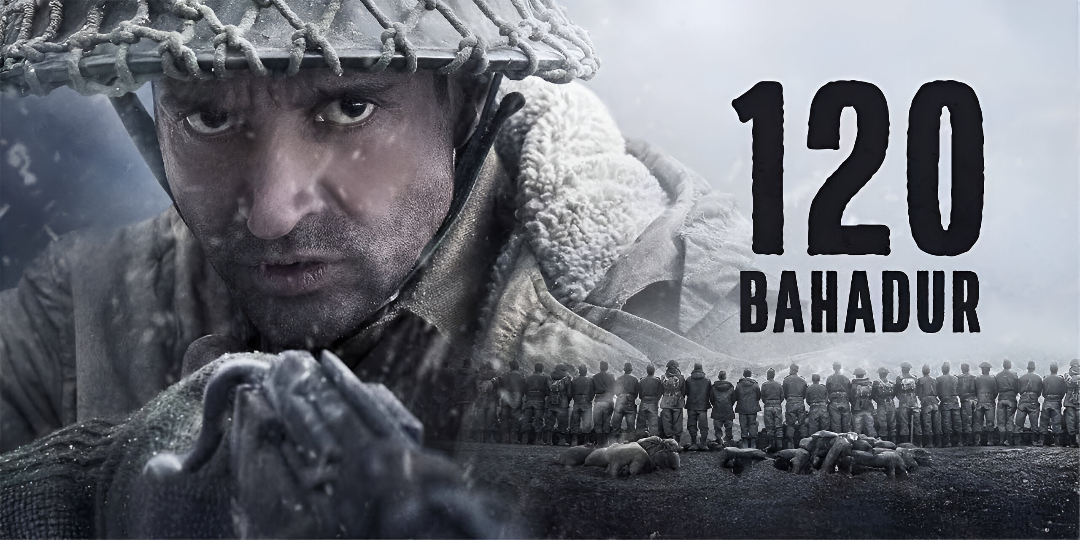
Few films mirror the scale of the story they aim to tell. 120 Bahadur, based on the Battle of Rezang La, is one of them. What began as a tribute to the legendary 13 Kumaon soldiers transformed into a formidable production journey marked by extreme climates, relentless physical strain, and an uncompromising pursuit of authenticity by director Razneesh “RAZY” Ghai, and produced by Ritesh Sidhwani, Farhan Akhtar (Excel Entertainment) and Amit Chandrra (Trigger Happy Studios).
Filmed in the Heart of the Himalayas
To capture the reality of the 1962 battle, the crew chose locations in the high-altitude Himalayan region, where temperatures dropped below freezing and oxygen levels were drastically low. Shooting schedules frequently shifted due to harsh winds, unstable terrain, and logistical hurdles.
The cast and crew worked in conditions that mirrored those faced by soldiers decades ago. “Even standing still was demanding,” a crew member shared. Equipment had to be manually transported to the mountaintops, often in multiple trips, turning simple tasks into hours of labour.
Authenticity Built from Scratch
The production design team undertook extensive research to recreate the 1962 environment. Old photographs, archival notes, and army references became the foundation for constructing era-accurate tents, gear, and battlefield layouts.
Hundreds of Indian and Chinese soldier extras were dressed and equipped daily, requiring an assembly-line strategy to manage costumes, props, and military kits. Many set elements from trenches to shelters were hand-built to stay true to period details.
A Cast Immersed in the Conflict
Farhan Akhtar leads the ensemble, bringing an emotional intensity shaped by the terrain itself. Special appearances by Raashii Khanna and others add dimension, while newcomer Sparsh Walia makes his debut in an environment far removed from conventional sets.
Actors recount moments of real struggle, retakes due to shifting light, scenes halted due to sudden snowfall, and physical exhaustion from climbing steep ridges. Ankit Siwach revealed that delays and performance pressures nearly cost him his role at one point, underscoring the high-stakes nature of the production.
For many, the defining moment was wearing the authentic military uniform. “You feel the weight of the men who actually fought there,” one actor noted.
The Director’s Personal Mission
For RAZY Ghai, whose family has a military background, the film is deeply personal. The director remained committed to the project through multiple setbacks over the years. His insistence on realism shaped not just the film’s visual identity but its emotional core.
The team also included international talent such as cinematographer Tetsuo Nagata, alongside a music department led by Amit Trivedi and Javed Akhtar, bringing a multicultural creative energy to the project.
A Film That Was Built, Not Just Shot
The team repeatedly describes 120 Bahadur as a labor of love, a project that demanded personal sacrifices, technical ingenuity, and unwavering perseverance. In their words, the film was not merely shot; it was built, piece by piece, through determination.As the film approaches release, its behind-the-scenes journey stands as a testament to the resilience of its makers. Much like the men of Rezang La, the team behind 120 Bahadur forged ahead against overwhelming odds to bring a story of courage, loyalty, and sacrifice to the screen.